Showing posts with label Vassalboro. Show all posts

May 27, 2011

Maine State Police Pipe and Drum Unit

(From left, Detective Scott Gosselin, Trooper Kyle Willette, Trooper Trevor Snow, and Trooper William Plourde. The Maine State Police Pipe and Drum Unit performs at various functions around the state, including the 20th BLETP Graduation on May 13. Members also performed at the Law Enforcement Memorial in Augusta on May 12.)

By Katy England
edge staff writer
kengland@themaineedge.com

When you think of all the specialized units that come under the purview of the Maine State Police, musical talent may not be the first thing that leaps to mind. However, for the past 15 years, there has been a group of dedicated souls that make up the Maine State Police Pipe and Drum Unit. The ensemble consists of bagpipers and snare, tenor, and bass drummers.
The unit was formed back in 1996 by Scott Nichols, Jim Jones, Lance McCleish and Rick McAlister with the first performance being held in 1998. Nichols and Jones spent undertook the considerable challenge of learning how to play the bagpipes from scratch.
“I’ve always been a drummer, and I played in bands even when I wasn’t working as a trooper,” said McAlister in a phone interview. “I happened to be teaching a class, and there was a student from the New Hampshire in a pipe and drum unit who invited me down to the graduation. I saw them perform and decided we could put something together.”
McAlister said the group purchased all of their own equipment – which, when you consider that the instruments were between $600 to $800 and the kilt and accessories cost around $300 to $500, is no small investment – and began recruiting people to come and play.
The members of the Pipe and Drum Unit are spread all over the state, making rehearsal time a premium.
But the unit dedicates a lot of time to mastering a small repertoire of music, so when they do perform, they sound great.
And unlike other specializations, not all of the members of the unit are sworn troopers. But there is a tie to public safety, be it the director of Maine Emergency Services or the Maine Department of Environmental Protection.
Currently the unit is made up of Trooper Trevor Snow, Trooper Kyle Willette, Retired Lieutenant Gerard “Red” Therian, DEP/Senior Environmental Engineer Tim MacMillan, EMS Director Jay Bradshaw, Retired Sergeant Rick McAlister, Trooper William Plourde and Detective Scott Gosselin. There are a few newcomers who are also learning the ropes, but McAlister said it might be a little while before they’re ready for a live performance.
Finding musicians to dedicate the necessary time can be challenging, but that didn’t stop the two sworn troopers who currently play in the unit from picking up the bagpipes – from scratch. Bagpipes are notorious for being a difficult instrument to master, but Troopers Trevor Snow and Kyle Willette, like some of the founding members, met that challenge.
“When I worked at the academy, I was involved in some of the training classes. The pipe and drum unit has historically played for the graduating classes. The pipe and drum unit always interested me and I thought I’d like to learn to play the bagpipes,” said Snow in a phone interview. “I contacted Sgt. Nichols and Director Jay Bradshaw, who has functioned as Pipe Major, and he taught me how to play the bagpipes so I could join the unit.”
That makes it sound incredibly simple, but Snow noted it took him a year of dedicated practice before he played his first event with the Pipe and Drum Unit.
“If you’re starting from scratch it’s going to take a lot of work and a lot of practice,” said McAlister. “Maybe it’s just that thing that troopers have; for these guys to pick up an instrument – the bagpipes – and stay committed to it.
“I like it because it’s a unique representation for our agency. I’m able to represent the state police in a unique manner and it affords a nice opportunity to represent law enforcement as a whole,” said Snow.
The Pipe and Drum Unit performs at various functions across state and New England, including all of the Basic Law Enforcement graduations at the Maine Criminal Justice Academy since they combined the school 10 years ago. The unit also performs at memorial services, including the Law Enforcement Memorial that was held on May 19.

May 26, 2011

45 cadets graduate from MCJA


20th Basic Law Enforcement Training Program graduation

By Katy England
edge staff writer
kengland@themaineedge.com

VASSALBORO – After 18 weeks of intense training, the 20th Basic Law Enforcement Training Program cadets graduated on May 13 at the Maine Criminal Justice Academy in Vassalboro.
45 cadets walked across the stage after having their badge pinned to their uniform, signifying the transition from cadet to law enforcement officer.
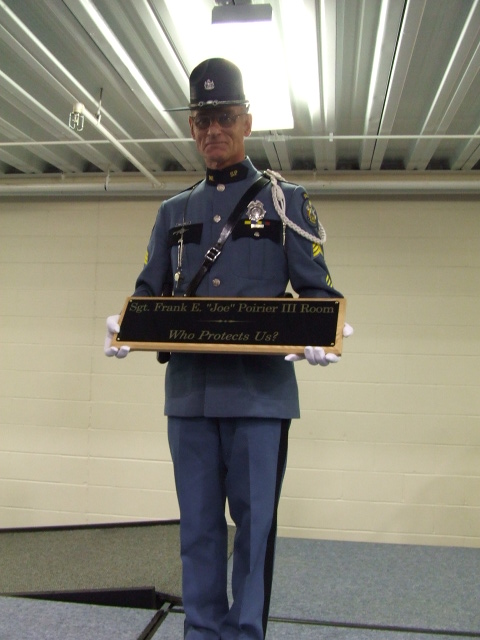
Director John Rogers took time to acknowledge the retirement of Sgt. Joe Poirier, but named the Professionalism Proficiency Award after him. He also dedicated one of the rooms at the academy the Frank E. “Joe” Poirier Room, with the quotation “Who protects us” inscribed upon it.


Class awards were issued to cadets who excelled in various fields. Officer Caleb McGary of the University of Maine Public Safety was named class valedictorian and issued the Academic Proficiency Award, Combined Practical Skills Proficiency Award, the Professionalism Proficiency Award and the Randall Parsons Iron-Man Award; Officer Bryan J. Parker of the Auburn Police Department and Troopers Kyle D. Pelletier and Samuel D. Quintana were tied for the Sid Bridges Firearms Proficiency Award; Officer Dennis Matthews of the Auburn Police Department received the Emergency Vehicle Operation Course Proficiency Award; Trooper Benjamin K. Sweeney of the Maine State Police received the Charles How IV Physical Fitness Award; and Trooper Jillian M. Monahan of the Maine State Police and Officer Bryan J. Parker of the Auburn Police Department shared the Mechanics of Arrest, Restraint and Control Proficiency Award.
The cadets stay at the Academy Monday through Friday, returning to their homes across the state on weekends for the duration of the training.

The graduates are listed below.

David L. Arsenault, Knox County Sheriff’s Office
Christopher R. Baez, Maine State Police
Matthew P. Bell, Biddeford Police Department
Reid C. Bond, Maine State Police
Tucker L. Bonnevie, Maine State Police
Kristie A. Bouchard, Brewer Police Department
Robert W. Carr, York County Sheriff’s Office
Brent A. Chasse, Maine Marine Patrol
David Coflesky, Maine State Police
Nicholas D. D’Angelo, Maine State Police
Wayne H. Drake, Farmington Police Department
Joshua R. Engroff, Baileyville Police Department
Duane K. Fay, York County Sheriff’s Office
Thomas P. Ferrier, Boothbay Harbor Police Department
Troy R. Francis, Penobscot Nation Warden Service
Ryan W. Freeman, Bangor Police Department
Scott R. Hendee, Biddeford Police Department
Christopher M. Kelley, Portland Police Department
Thomas W. Kwok, Maine State Police
Cody E. Laite, Camden Police Department
Ryan D. Lawson, Mount Desert Police Department
Michelle E. Legare, Fryeburg Police Department
Heath L. Mains, Saco Police Department
Paul M. Mason, Maine State Police
Dennis V. Matthews, Auburn Police Department
Kyle S. McDonald, MCJA Tuition Student
Caleb H. McGary, University of Maine Public Safety
Todd W. McGee, Cumberland County Sheriff’s Office
Jillian M. Monahan, Maine State Police
Matthew W. Moorhouse, Freeport Police Department
Eddie H. Murphy, Sanford Police Department
Benjamin J. Murtiff, Augusta Police Department
Todd D. Nyberg, Augusta Police Department
Bryan J. Parker, Auburn Police Department
Kyle D. Pelletier, Maine State Police
Brandon P. Perry, Windham Police Department
Jonathan D. Provisor, Auburn Police Department
Eric P. Quatrano, Windham Police Department
David L. Quinn, Penobscot County Sheriff’s Office
Samuel D. Quintana, Maine State Police
Christopher T. Schofield, South Portland Police Department
Andrew M. Simmons, Augusta Police Department
Jason T. St. John, Westbrook Police Department
Benjamin K. Sweeney, Maine State Police
Kyle M. Wells, Maine State Police

May 22, 2011

School of Hard Knocks

VASSALBORO – Many college kids are heaving sighs of relief as they finish finals and head home. The same holds true for those who have recently entered the field of law enforcement and are wrapping up their 18 weeks at Maine Criminal Justice Academy (MCJA). They receive grades as well – it’s the tests that are slightly different.
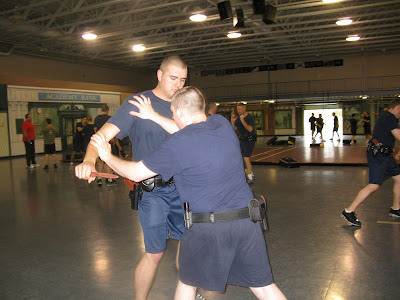
Throughout the course of their stay at the MCJA, cadets are trained in various fields, from criminal and traffic law to alcohol enforcement and much, much more. One of the courses is the Mechanics of Arrest Control and Restrain (MARC), where they learn the basics of placing a subject under arrest (you can read more about this in the December issue “Hands-on Learning”). But in order to show that they have not only learned the maneuvers, but can apply them under duress, the cadets participate in scenario-based testing towards the end of the academy. The cadets are put under stress, and then have to “arrest” an instructor – who doesn’t make easy.
“It’s important for cadets to be prepared to begin working on the road,” said Sgt. Scott Hamilton, one of the lead MARC instructors at the academy. “[The scenario fights] build confidence and show them they can accomplish their goal of taking people to jail.”
With approximately 44 cadets, it can take awhile to go through the scenarios and the grading. MARC instructors from across the state, some who have been assisting with the MARC course, assist with the scenarios, which can leave lasting impressions. Helping out can mean scrapes, bruises and more.
“I do it to make the cadets better and give them a real-life experience,” said Marine Patrol Officer Rustin Ames. “We want to prevent them from getting killed on the road.”
The scenarios are designed to be difficult, but for good reason. Altercations on the road are intense and don’t follow the rules you’d see in boxing or even Mixed Martial Arts fights.
“The practical scenarios simulate an actual encounter on the road between a combative subject and an officer,” explained Hamilton. “It allows the cadet to hone their skills in a controlled setting.”

Jan 14, 2011

Funeral for Maine State Police lieutenant to be held Monday

Lt. Charles "Chip" Howe

Courtesy of Maine Public Safety

VASSALBORO - Adjacent to a room that bears his name, funeral services for retired State Police Lieutenant Charles Howe will take place Monday at 10 a.m. at the Maine Criminal Justice Academy in Vassalboro.  Howe, better known as “Chip,” died early Wednesday morning at his home in Vassalboro after declining health from a rare neurological disease.  He was 59.

He served the State Police for 31 years – the last 18 of those years in the training division – and he played a hand in the training of every police officer and state trooper in Maine from 1987 to his retirement in 2005.  The academy was located on Silver Street in Waterville for most of those years, but Howe also helped oversee the relocation of the academy in 2001 to the former Oak Grove Coburn School in Vassalboro, where his services will take place Monday.

Chip joined the State Police in 1974 and initially patrolled in Troop F (Aroostook County) and Troop J (Washington & Hancock counties). He was named Trooper of the Year in 1983 and transferred to the academy in 1987 as a sergeant and was promoted to lieutenant in charge of training in 1995.  During those 18 years he served at the academy, close to 2,000 Maine police officers were trained there.  The weight room in the training center is named in his honor.

Following his retirement, Chip served as an analyst for the State Police Computer Crimes Unit. Prior to joining the State Police, Chip was a watchman for the Maine Forest Service on top of Bigelow Mountain and he also served as a forest ranger. In all he had 37 years of state service. Always physically fit – he was an avid skier, runner, bicyclist and hiker.

He is survived by his wife, Jane, and four grown children.

Dec 3, 2010

Hands on learning: the cutting edge

This is part of an ongoing blog where I shadow the 19th BLETP cadets as they go through MARC training at the Maine Criminal Justice Academy. To start at the beginning, click here.


VASSALBORO – When things turn violent anything can happen, including a subject pulling a knife. The cadets learned how to react when a blade enters the game, ways to prevent it from being draw and stop the subject from stabbing them.


They cadets were paired off and one was given a red rubber knife that the other cadet had to defend against.


The cadets also learned several new takedown techniques and kicks as well as receving a ground fighting review from Det. Paul Fenton and Cpl. Dan Beaulieu of the Cape Elizabeth and Saco Police Departments respectively.

Nov 30, 2010

Hands on learning: Carry a big stick

This is an ongoing blog where I shadow the 19 BLETP's cadets as they go through their MARC training at the Maine Criminal Justice Academy. You can start from the beginning by clicking here.

VASSALBORO – In addition to a few new distraction techniques (a fun move called the “skeleton yank” and a control technique commonly referred to as the “gooseneck”) the cadets learned some ways to use their collapsible batons in non-deadly force situations.
There are ways to use it for pain compliance while it’s collapsed and also using it for striking.


But in addition to learning how to use the batons (though, this didn’t count as a certification couse), the cadets also learned how to defend against someone using the weapons against them.


Nov 23, 2010

Hands on Learning: Putting it all together


This is an ongoing blog that shadows the 19th BLETP cadets as they participate in MARC training at the Maine Criminal Justice Academy. To start at the beginning, click here.

VASSALBORO – The cadets face off against different instructors and have to take them into custody. The instructors offer various levels of resistance, from compliance, non-violent non-compliance to full-blown physical resistance and fighting.


After each scenario the class deconstructs what happened. Instructors and cadets offer tips and advice on how the cadet could have done better and praise for techniques that worked well.

Afterwards, the cadets learned how to escape from headlocks, bearhugs and other dangerous holds.

Nov 4, 2010

Home on the range: cruiser control

This is an ongoing blog where I shadow the 19 Basic Law Enforcement Training Program cadets from the Maine Criminal Justice Academy through some of their training. Start reading about the defensive tactics training here. Read about the firearms training here.

(Objects in mirror are chasing you)


Cruiser control

Emergency Vehicle Operation and Control (EVOC) is just what it sounds like: being able to control your vehicle. The idea wasn’t so much to learn how to drive at high rates of speed, but to be able to control the vehicle as efficiently as possible.

The EVOC instructors for the week I was there included Lead Instructor Trooper Jack Dow of the Maine State Police Troop K, Sgt. John O’Malley of the Scarborough Police Department, Trooper Adam McNaughton of the Maine State Police Troop D, Trooper Marc Poulin of the Maine State Police Troop D, Sgt. Jason Nein of the Lincoln County Sheriff’s Office, and Trooper Bernard Branette of the Maine State Police Troop K.

Throughout the week the cadets have to be able to put a cruiser through various different maneuvers at low, medium or high speeds. On Oct. 14, they were working on braking turns, where they come into a turn going around 50 miles per hour.

Other maneuvers include a serpentine, where cones are set up in something of a slalom formation 100 feet apart and the cadets have to maneuver between them at 40 mph without touching a cone. The evasive maneuver is when the cadet is driving with an instructor and they come to a point in the course where they have to turn left or right, and about 20 feet before the cones obstructing the path the instructor calls out “left” or “right” and they have to turn the proper direction. Occasionally, the instructors won’t call out and it’s up to the cadet to still avoid the obstacles. There is also a low-speed precision obstacle course where they have to move the cruisers through a tight network of cones.

When the cadets are tested it’s based on how quickly they made it through and how many cones they hit. This is to add the element of stress to the cadets to add stress to the situation to emulate the stress the cadets will face when they are out on the road.

(Inches to spare)

There’s also the reverse serpentine, where they do the same as the serpentine, except slower and backwards. The same is true for the reverse obstacle course.

The instructors explained that the courses are designed to simulate actual driving experiences. The evasive maneuver is to simulate an animal or person running out into the roadway.
“These are diminishing skills,” said Sgt. O’Malley. If you don’t use them every day they go away.”

He noted that inclement weather doesn’t change how you have to handle the cruiser, but at what speeds things can go out of control.

“Everything is the same, but you just start to slide at a low speed in rain and snowy conditions,” he said.

They have to do all of these maneuvers during the day and at night.

They were also instructed in the use of spike strips (also known as spike mats) and how they are deployed and removed during a chase. They used spike-less mats to get used to tossing them out and pulling them back.
(Spike strips going out)

(Spike strips being run over, spike-free, of course)
The night I was there the cadets also had to attempt a pursuit during the day and at night. This involved some of the instructors driving past the cadets and doing something that would be a moving violation (donuts in the road, swerving off pavement) and then have the cadets pursue them. The cadets are trained to use the cruiser correctly, meaning calling in on their radios, activating their blue lights, staying on the legal side of the road, and slowing down for stop signs and yield signs (Sgt. O’Malley explained that if using the lights and siren, police don’t have to come to a complete stop, but they have to be able to in the case of oncoming traffic or other obstacles in the road).

(The cruiser with the smoking tires is the "bad guy")

The importance of being able to use the cruisers efficiently is made clear, as someone without this kind of training will be putting a vehicle through quite a beating if they don't know what they're doing.

There's a lot that goes into these maneuvers, from when to speed up to when to hit the brakes,which varies depending on the speed that the cruiser is going. What looks easy in the movies takes a great deal of skill and understanding in real life.

"It gives you a better understanding of how the suspect drives and a better understanding of what [the other driver] is going through and makes us much more prepared than any civilian," said Cadet Derek Abbott, a patrol officer for Portland Police Department. "The overall tactical aspect [of EVOC] is unique. High speed pursuit is challenging ... if there's one thing this week has taught me is humility."

One thing that I noticed in the scant amount of time I was able to spend with the cadets is how quickly they were able to pick up these skills. One could literally hear the difference as they learned how to control their cruisers at decently high speeds (50 mph) as they took a turn. In the early morning, there was the occasional tire squeal, but by late morning to early afternoon they were rounding the corners without so much as a whisper.